

Guides
What Better Odds Actually Mean
A plain guide to ticket caps, competition odds and how holding more than one entry changes your share of a draw.

Agora Competitions
Editorial team
Published 27 August 2026 · 5 min read
"Better odds" simply means a higher chance of winning. It does not mean a win is likely or guaranteed.
In a draw where every valid ticket has an equal chance, the most important numbers are the size of the final entry pool and the number of tickets you hold.
This article explains the basic maths and the difference between a ticket cap, a final entry pool and a customer entry limit. If you would rather try the numbers yourself, use our interactive odds calculator.
Start with one simple calculation#
For a draw with one main-prize winner, your chance is:
Your valid tickets ÷ total valid tickets in the draw
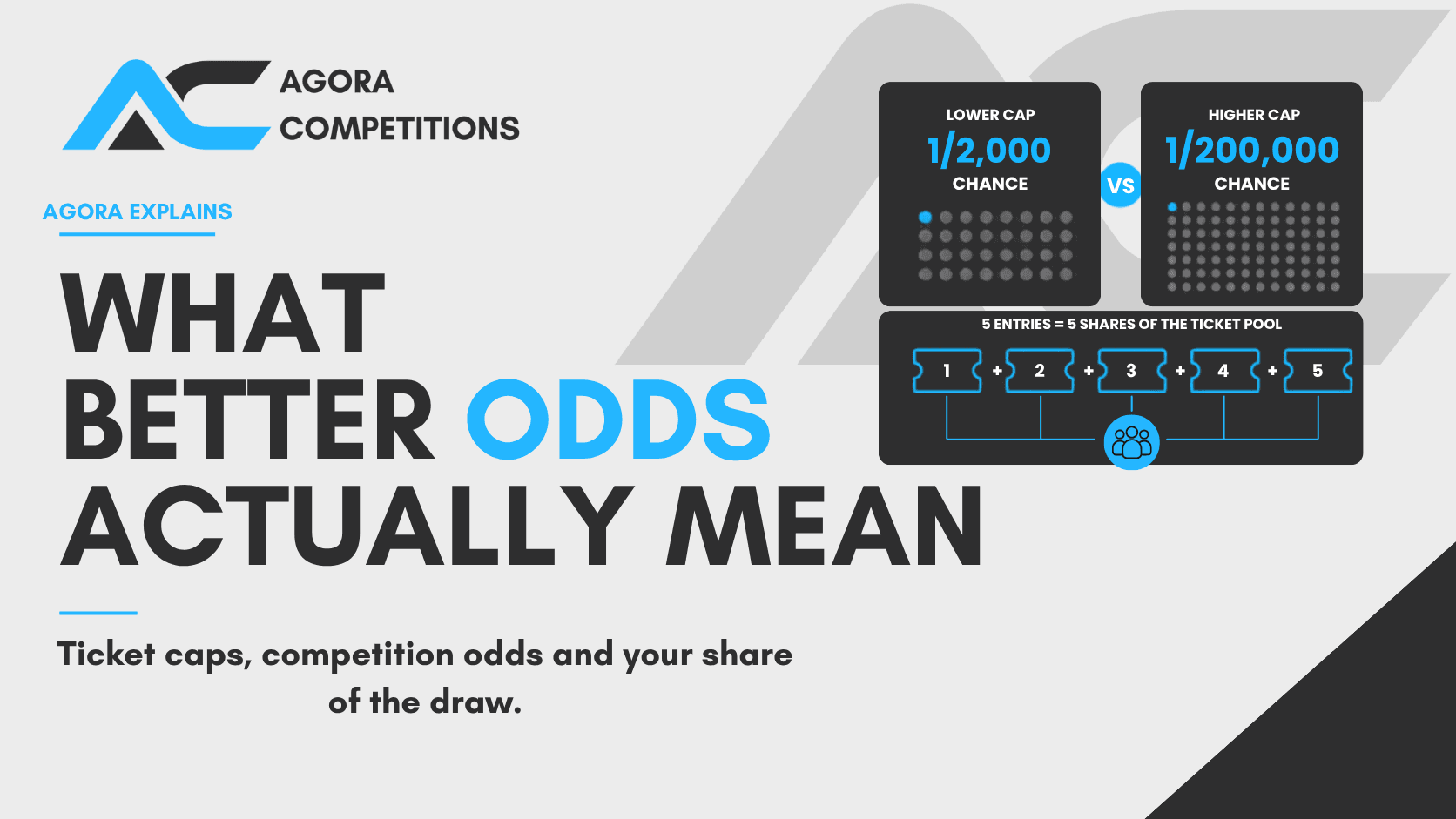
If the final draw contains 2,000 valid tickets and you hold one, your chance is:
1 ÷ 2,000 = 0.05%
This is usually described as 1 in 2,000.
If another competition has 200,000 valid tickets and you hold one, your chance is:
1 ÷ 200,000 = 0.0005%, or 1 in 200,000.
The first ticket is not more powerful. It is competing against a much smaller pool, so it represents a larger part of the draw.
Better odds do not mean a guaranteed win. They mean your entry represents a larger share of the draw.
What a ticket cap actually tells you#
A ticket cap is the maximum number of tickets that can be issued for a competition. It tells you the largest the draw can become.
It does not necessarily tell you how many tickets will be in the final draw. A competition capped at 2,000 tickets might close with only 1,250 eligible entries issued. In that case, the final calculation uses 1,250, not 2,000.
That is why there are two numbers worth understanding:
- Maximum entry pool: the published ticket cap.
- Final entry pool: the valid paid and free postal entries included when the competition closes.
What changes when you hold more tickets?#
Each valid ticket is another equally weighted position in the draw. In a 2,000-ticket pool:
| Your tickets | Calculation | Main-prize chance |
|---|---|---|
| 1 | 1 ÷ 2,000 | 0.05% (1 in 2,000) |
| 4 | 4 ÷ 2,000 | 0.20% (1 in 500) |
| 10 | 10 ÷ 2,000 | 0.50% (1 in 200) |
| 20 | 20 ÷ 2,000 | 1.00% (1 in 100) |
| 100 | 100 ÷ 2,000 | 5.00% (1 in 20) |
If the total pool stays the same, doubling your tickets doubles your chance. For example, moving from 10 tickets to 20 raises the probability from 0.5% to 1%.
How to compare two competitions#
Suppose two competitions offer the same £500 prize at the same 25p ticket price. You plan to hold 20 tickets in either one.
| Competition A | Competition B | |
|---|---|---|
| Maximum entry pool | 2,000 | 20,000 |
| Your tickets | 20 | 20 |
| Chance if sold out | 1% (1 in 100) | 0.1% (1 in 1,000) |
The prize, price and number of tickets you hold are identical. Competition A has the better main-draw odds because its maximum pool is smaller.
That does not automatically make it better value. The prize, ticket price, competition rules and your budget still matter.
Ticket caps and customer entry limits are different#
A ticket cap limits the competition as a whole. A customer entry limit restricts how many tickets one person can hold.
For example, a competition might allow 2,000 tickets in total but no more than 100 per customer. If it sells out, a customer holding the maximum has:
100 ÷ 2,000 = 5%
The customer limit does not reduce the 2,000-ticket competition cap. It limits how much of that pool one customer can hold.
What happens if the competition does not sell out?#
Suppose you hold 20 tickets in a competition capped at 2,000.
- If all 2,000 tickets are issued, your chance is 1%.
- If 1,000 eligible tickets are issued, your chance is 2%.
- If 500 eligible tickets are issued, your chance is 4%.
Your tickets have not changed; the final pool has. This is why the ticket cap gives you the longest possible odds, while the exact main-draw odds are only known after entries close and are validated.
So should I calculate my odds before entering?
You can calculate your chance at the maximum pool from the published ticket cap. The exact final probability is not known until the competition closes because more eligible tickets can be issued before the deadline.
Main-draw and instant-win odds are different#
The calculation above describes a single main-prize draw. Instant wins use a different calculation because there can be several winning ticket positions across the pool.
Keep the two questions separate:
- What is my chance of the main-draw prize?
- What is my chance of holding at least one instant-win ticket?
The answer depends on the rules and remaining prizes for that competition. Our calculator shows both calculations side by side.
What odds cannot tell you#
There is no universal point at which odds become "good". Better odds are always relative: 1 in 2,000 is better than 1 in 20,000, but both outcomes remain uncertain.
Odds also do not tell you whether a competition is good value or right for you. Before entering, consider:
- the prize and price per ticket
- the ticket cap and customer entry limit
- the competition rules and closing date
- how much you are comfortable spending
Competitions are games of chance. Treat them as entertainment, set a budget and never assume that more tickets will produce a win.
The takeaway#
For a one-winner main draw, remember one formula:
Your valid tickets ÷ total valid tickets = your chance of winning
A smaller pool gives each ticket a larger share. Holding more tickets increases your share. The ticket cap shows the largest possible pool; the final eligible entry count determines the actual result.
Better odds improve the probability. They do not guarantee the outcome.
Try the numbers yourself#
Enter any pool size, ticket quantity and number of instant wins to see how each figure changes.