

Guides
What Makes a Competition Good Value?
A practical guide to judging competition value using the prize, entry price, ticket cap, entry limits and the information available before you enter.

Agora Competitions
Editorial team
Published 31 August 2026 · 8 min read

A good value competition is not simply the one with the cheapest entry price or the biggest prize.
You need to look at the whole structure: what you can win, what each entry costs, the ticket cap, the customer entry limit and how much information is available before you decide to enter.
Those numbers tell you much more when they are considered together.
Start with the whole offer, not one number#
It is easy to focus on a single headline.
A competition might advertise a large prize. Another might promote very cheap entries. Another might have a small ticket pool.
None of those things tells you the full story on its own.
For example, a 25p entry can look inexpensive, but its value depends partly on how many tickets could be in the draw. A £1 entry can look more expensive, but a much smaller ticket cap may mean each individual entry represents a larger share of the possible pool.
The useful question is not simply, "How much is one ticket?"
It is:
What do I get for that price, and how does the competition structure affect my possible share of the main draw?
Five things to check before you enter#
1. The prize#
Start with what is actually being won.
For a cash competition, the value is straightforward. A £250 cash prize is worth £250.
For products, experiences or bundles, think about the value to you rather than relying only on a headline retail figure. A prize can have a high advertised value and still be poor value for you personally if it is something you would not want.
You should also be able to understand exactly what is included. If the prize has optional alternatives, restrictions or conditions, those should be clear before entry.
2. The entry price#
The entry price tells you what one paid entry costs.
It is useful, but it should always be considered alongside the ticket cap.
Imagine two competitions offering the same £250 prize:
| Competition A | Competition B | |
|---|---|---|
| Entry price | 25p | 99p |
| Ticket cap | 1,000 | 300 |
| Customer entry limit | 100 | 50 |
Competition A is cheaper per entry.
Competition B has a smaller possible pool.
Neither fact automatically makes one competition better value. You need both pieces of information before you can compare them properly.
Discount codes, promotions and free entry routes can also affect what individual customers actually pay, so the standard entry price is only one part of the picture.
3. The ticket cap#
The ticket cap is the maximum number of tickets that can exist in the competition.
This matters because it sets the largest possible main draw pool.
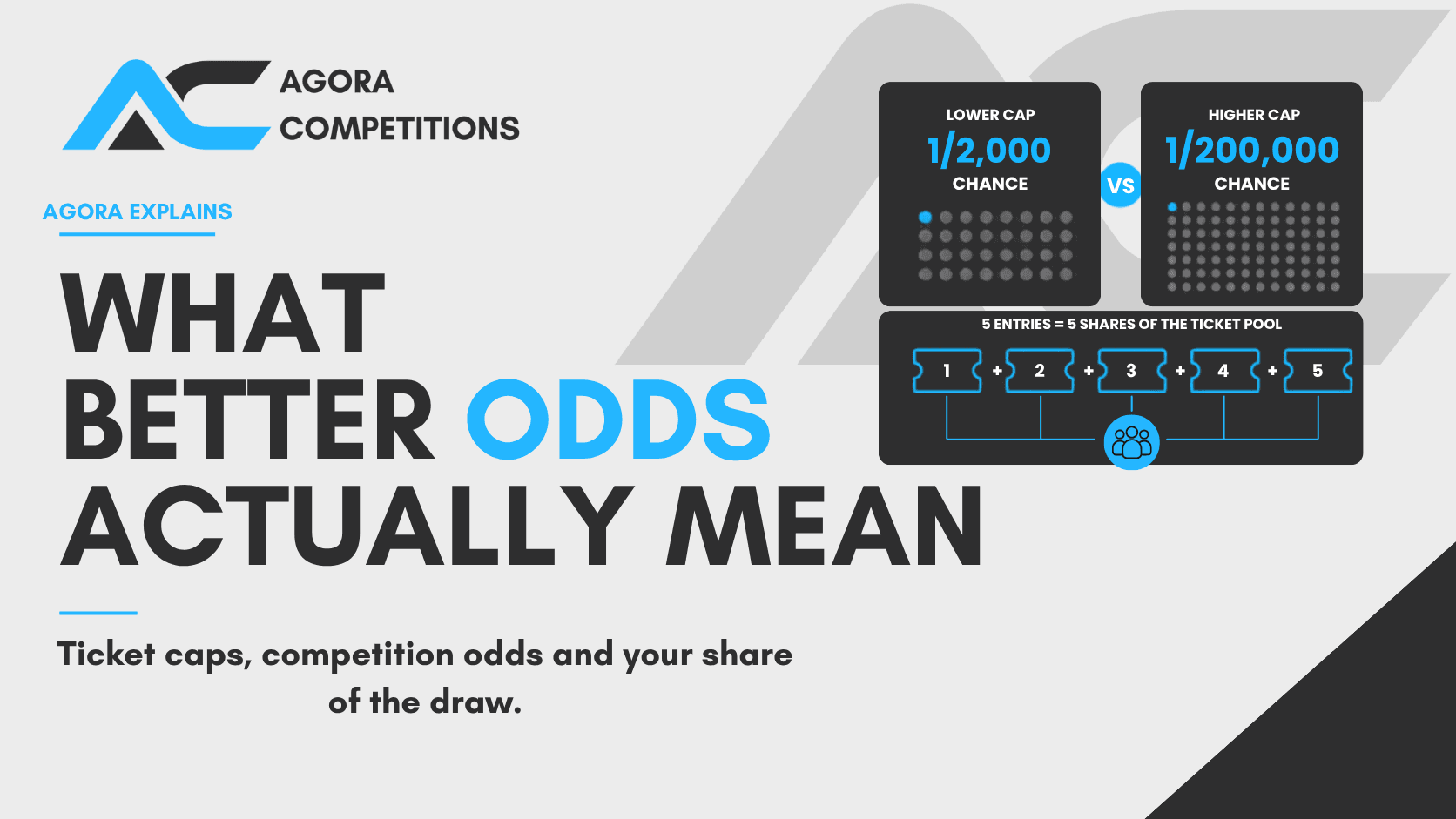
If a competition has a 1,000 ticket cap, one entry would represent 1 out of 1,000 possible tickets if the cap were reached.
If another competition has a 100,000 ticket cap, one entry would represent 1 out of 100,000 possible tickets if that cap were reached.
That does not tell you how many entries will actually be in the draw. The cap is a maximum, not a final figure.
The final entry pool is the eligible paid and free postal entries included when the draw takes place. It may be lower than the ticket cap if the competition does not fill.
If a site shows live availability, that can help you understand how the competition is progressing before entries close. The final pool can still change until the competition closes.
For a fuller explanation of this distinction, read What Better Odds Actually Mean.
4. The customer entry limit#
The customer entry limit is the maximum number of entries one person may hold.
This is different from the ticket cap.
A competition could have a 1,000 ticket cap and a customer entry limit of 100. Another could have the same ticket cap but allow one customer to hold 500.
That changes how concentrated entries can become.
A lower customer entry limit does not make winning likely, but it can stop a small number of customers from holding a very large share of the available tickets.
When you compare competitions, check both numbers:
| Question | Figure to look for |
|---|---|
| How many tickets can exist overall? | Ticket cap |
| How many can one customer hold? | Customer entry limit |
| How many eligible entries are actually in the draw? | Final entry pool |
These figures answer different questions and should not be treated as interchangeable.
5. The information available before you enter#
Value is not only about price and probability.
A competition is easier to judge when the important information is available before you pay.
At a minimum, you should be able to understand:
- what the prize is;
- how much an entry costs;
- the ticket cap;
- the customer entry limit;
- when entries close;
- when and how the winner will be selected;
- whether a free entry route is available;
- any skill or eligibility requirements;
- where the competition rules can be read;
- what happens after a winner is selected.
If key information is difficult to find, you cannot properly assess the competition before entering.
Transparency does not change the mathematical probability of winning. It does make it easier to decide whether the competition is right for you.
A worked example#
Return to the two hypothetical £250 competitions.
| Competition A | Competition B | |
|---|---|---|
| Prize | £250 cash | £250 cash |
| Entry price | 25p | 99p |
| Ticket cap | 1,000 | 300 |
| Customer entry limit | 100 | 50 |
| One entry if the cap is reached | 1 in 1,000 | 1 in 300 |
| Maximum entries if the cap is reached | 100 in 1,000 | 50 in 300 |
| Maximum entry spend at standard price | £25 | £49.50 |
At first glance, Competition B has the stronger probability for a single entry because the ticket cap is smaller.
If both competitions reached their ticket caps, one entry would represent 1 in 300 of Competition B compared with 1 in 1,000 of Competition A.
But the entry prices are different.
If someone spent roughly £25 at the standard price, they could hold:
- 100 entries in Competition A for £25;
- 25 entries in Competition B for £24.75.
Under the same full cap assumption, that would represent:
- 100 out of 1,000 entries in Competition A, which is 1 in 10;
- 25 out of 300 entries in Competition B, which is 1 in 12.
That does not mean Competition A is automatically "better". It shows why entry price and ticket cap need to be compared together.
It also shows why looking only at the strongest possible odds can be misleading if reaching those odds requires spending more.
A higher probability is still only a probability. It is never a guaranteed win.
The final entry pool matters too#
Ticket caps are useful because they let you compare the maximum possible size of competitions before entering.
But the actual main draw takes place using the final entry pool.
Suppose a competition has a ticket cap of 1,000 but closes with 620 eligible entries.
If you held one eligible entry, your share of that final pool would be 1 out of 620 rather than 1 out of 1,000.
That can only be known once the final entry pool is locked.
For that reason, a responsible comparison should distinguish between:
Maximum figures, which can be known in advance.
Final figures, which are only confirmed once entries close.
A competition should not describe a maximum ticket cap as though it were the guaranteed final pool.
What about instant wins?#
Instant wins can add extra value to a competition, but they should be considered separately from the main draw.
An instant win gives you a separate chance of receiving an advertised instant prize under that competition's rules. It does not automatically improve the probability of winning the main prize.
When comparing competitions, ask two separate questions:
- Is the main draw good value based on its prize, price and entry structure?
- Are any instant win prizes useful additional value to me?
Keeping those questions separate makes the comparison clearer.
Cheap entries are not always better#
A very low entry price can be appealing because it lowers the cost of taking part.
But cheap entries can still sit inside a very large ticket pool.
For example:
- 10p per entry with a 100,000 ticket cap;
- £1 per entry with a 500 ticket cap.
The first option is cheaper.
The second has a much smaller maximum pool.
Without looking at both figures, you cannot make a meaningful comparison.
The same applies in reverse. A smaller ticket cap does not automatically make an expensive entry good value.
A simple value checklist#
Before entering, ask yourself:
- Do I actually want the prize?
- Is the entry price clear?
- What is the ticket cap?
- What is the customer entry limit?
- Can I see the closing and draw information?
- Can I understand how the winner is selected?
- Is the free entry route explained?
- Are the rules easy to find before payment?
- Am I comfortable with what I am spending even if I do not win?
That final question matters.
Competitions should be treated as optional entertainment, not as a way to make money. Set a budget you are comfortable losing, and do not increase your spend simply because a competition is close to ending or because you have already entered.
The main takeaway#
Good value comes from the relationship between the prize, entry price, ticket cap, customer entry limit and the information available before you enter.
No single number tells you everything.
A cheap ticket can sit inside a large pool. A smaller pool can come with a higher entry price. A strong looking probability can require a much larger spend. A large prize can be difficult to assess if the competition structure is unclear.
The most useful competitions are the ones you can understand before you enter.